-
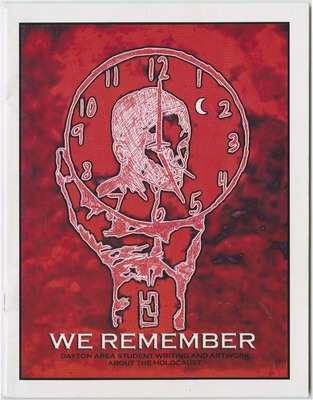
We Remember: Dayton Area Student Writing and Artwork about the Holocaust
Dayton Holocaust Resource Center
The study of the Holocaust involves very personal involvement by a teacher and the interaction of his or her students. The culmination oft his study may be writings or art that release the deep feelings stirred by this study.
For the past fifteen years we have conducted the Holocaust Writing Contest and the Max May Memorial Holocaust Art Contest to encourage this expression by students. Through the contests, we have seen some remarkable student work. Hundreds of Dayton-area public and parochial children in grades six through twelve have submitted their efforts. The level of sensitivity and creativity in these works of art, prose and poetry is a testament to their achievements and to the excellent instruction in Miami Valley schools. The winners in each category receive a U.S. savings bond and a certificate. All the art is exhibited at the Holocaust Remembrance program each spring at a local synagogue. Some ofthe art has also been exhibited at the U.S. Air Force Museum, the Montgomery County Courts building, the Dayton Jewish Center, and the K-12 Gallery.
We have repeatedly been asked to publish the winning prose and poetry. Now we present this booklet as a sampling of some of the best entries from the past six years. Initially, all the writing and art is judged by area experts. For this publication, several Holocaust Education Committee members read the entries carefully. Most are teachers, retired or still teaching. I appreciate their diligence and expertise.
The subject is difficult and the contests usually follow intense study of the Holocaust as appropriate for each grade level.
Our hope is that this study will help diminish prejudice and racism. Our wish is that these talented young people, and all those who enter the contests, will work to make this world a better, safer place.
-
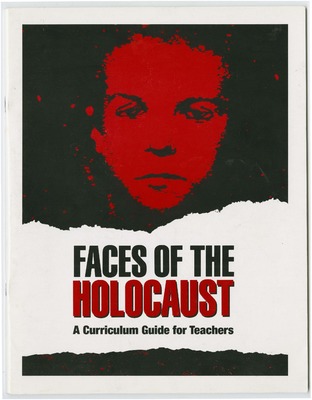
Faces of the Holocaust: A Curriculum Guide for Teachers
Challon Roberts and Thomas S. Martin
"Faces ofthe Holocaust" is a unique series of fifteen videotapes created expressly as a classroom resource and curriculum supplement. I began to record these one-of-a-kind stories in 1985 with Wright State University Television Center Initially, there were nine interviews over a three year period, which included painstaking editing. The second part of the series was filmed in 1995, the fiftieth year of liberation, with interviews of five more liberators and one more survivor. The series was directed by K. Roland Knight of Wright State University Television Center. Dr. Thomas Martin and Challon Roberts assisted me in the editing process.
Pictures obtained from survivors, liberators and rescuers from all over the world filled the edited videotapes with real images of that time period. It was still a novel idea at that time -to tape the stories of those who had actually witnessed and been part of the Holocaust. It was not always easy to convince survivors or liberators that their stories were of the utmost importance, that time was slipping by, and that these stories could only be told by those who had lived them. They bravely came forward and and somehow there was some healing in the recalling and telling of their stories. It was most difficult to bring back the memories of these horrible times and events that had wiped out their entire families and homes.
Nor was it without great effort for liberators to remember the horror they felt at seeing the human remains they encountered in the death camps. Yet, all the effort was worth it so that we could bring their stories to educate a new generation in the hope that these atrocities would never occur again to any people. This must be our goal -in all Holocaust education -helping to heal the world.
Materials from the Dayton Holocaust Resource Center.
Printing is not supported at the primary Gallery Thumbnail page. Please first navigate to a specific Image before printing.