-

How the Field was Colonized: Russian History's Ukrainian Blind Spot
Susan Smith-Peter and Sean Pollock
This discussion seeks to trace the origins of a particularly sympathetic approach to the Russian state and its needs with the field of Russian history in the United States. The response notes some of the major scholars who have greatly influenced the study of Russian history. These include Michael Karpovich, Richard Pipes, and Edward Keenan among others. The discussion grapples with the question of how Russian history in the US has or has not included Ukraine in its narrative and the terms of that incorporation. The original exchange, on H-Russia, comprised the first two commentaries. Susan Smith-Peter's response was not part of the original H-Russia post. Sean Pollock was not invited to respond.
-

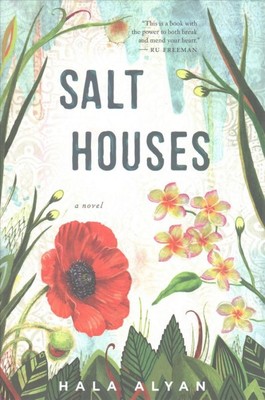
Salt Houses
Hala Alyan
"From a dazzling new literary voice, a debut novel about a Palestinian family caught between present and past, between displacement and home ... On the eve of her daughter Alia's wedding, Salma reads the girl's future in a cup of coffee dregs. She sees an unsettled life for Alia and her children; she also sees travel, and luck. While she chooses to keep her predictions to herself that day, they will all soon come to pass when the family is up rooted in the wake of the Six-Day War of 1967. Salma is forced to leave her home in Nablus; Alia's brother gets pulled into a politically militarized world he can't escape; and Alia and her gentle-spirited husband move to Kuwait City, where they reluctantly build a life with their three children. When Saddam Hussein invades Kuwait in 1990, Alia and her family once again lose their home, their land, and their story as they know it, scattering to Beirut, Paris, Boston, and beyond. Soon Alia's children begin families of their own, once again navigating the burdens (and blessings) of assimilation in foreign cities. Lyrical and heartbreaking, Salt Houses is a remarkable debut novel that challenges and humanizes an age-old conflict we might think we understand--one that asks us to confront that most devastating of all truths: you can't go home again"-
-
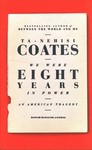
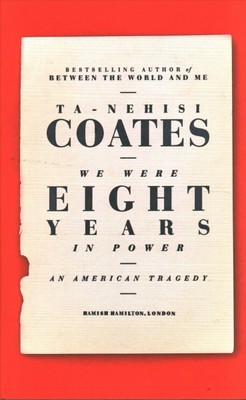
We Were Eight Years in Power
Ta-Nehisi Coates
We Were Eight Years in Power features Coates's iconic essays first published in The Atlantic, including Fear of a Black President, The Case for Reparations and The Black Family in the Age of Mass Incarceration, along with eight fresh essays that revisit each year of the Obama administration through Coates's own experiences, observations, and intellectual development, capped by a bracingly original assessment of the election that fully illuminated the tragedy of the Obama era. We Were Eight Years in Power is a vital account of modern America, from one of the definitive voices of this historic moment.
-
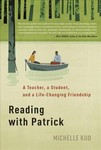
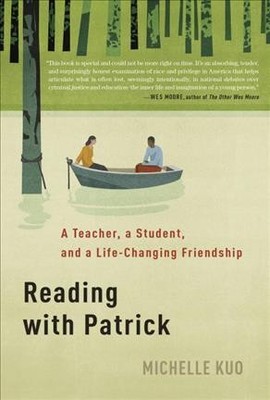
Reading with Patrick
Michelle Kuo
Recently graduated from Harvard University, Michelle Kuo arrives in the rural town of Helena, Arkansas, as an optimistic Teach for America volunteer. But she soon encounters the challenges of teaching at a school in one of America's poorest counties, still disabled by the legacy of slavery and Jim Crow. In this stirring memoir, Kuo, the child of Taiwanese immigrants, shares the story of her complicated but rewarding mentorship of one promising student, Patrick Browning, while he's in jail awaiting trial for murder. Michelle tutors Patrick, who is galvanised by the works of writers such as Frederick Douglass, James Baldwin, Walt Whitman, and W. S. Merwin, and undergoes a stunning literary and personal awakening. Reading with Patrick is a story of Michelle and Patrick's friendship and their mutual coming-of-age; a resonant meditation on education, race, and justice in the rural South; and a love letter to literature.
-
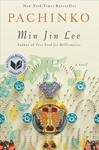
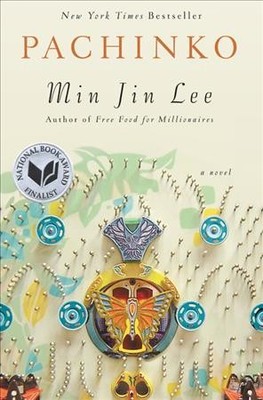
Pachinko
Min Jin Lee
"A new tour de force from the bestselling author of Free Food for Millionaires, for readers of The Kite Runner and Cutting for Stone. PACHINKO follows one Korean family through the generations, beginning in early 1900s Korea with Sunja, the prized daughter of a poor yet proud family, whose unplanned pregnancy threatens to shame them all. Deserted by her lover, Sunja is saved when a young tubercular minister offers
-
"Like It Is" Episode #630 -- Interview with Frankie M. Freeman
Arthur E. Thomas and Frankie M. Freeman
In this episode of "Like It Is" Attorney Frankie Freeman emphasizes the importance of registering and voting minorities across the country, not just in the South, to ensure political progress. She highlights the federal government's responsibility to support poor and oppressed communities through programs like Head Start and Job Corps, which serve all Americans regardless of race. Freeman reflects on her long career in civil rights, noting the significance of the Voting Rights Act and efforts to increase Black political representation. She advocates for Black candidates to run based on their commitment rather than race, and stresses the importance of ongoing voter registration and civic participation. Freeman also discusses her work in law and government, including her service under President Carter and her belief that Black colleges are vital to America's future. She urges Black people to stay vigilant, informed, and united in efforts to advance societal progress.
-
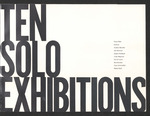
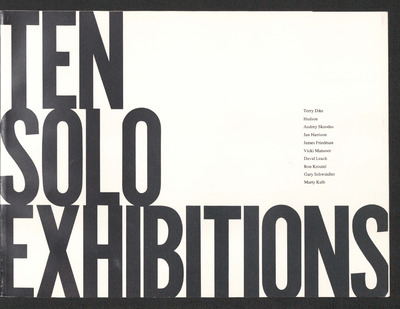
Ten Solo Exhibitions
Wright State University Art Galleries
A catalog featuring a series of exhibitions of work by selected Ohio artists presented from February through July 1982, made possible in part by the support of the Ohio Arts Council.
-
"Like It Is" Episode #423 -- Interview with Mrs. Mona Bailey
Arthur E. Thomas and Mona Bailey
This episode of "Like It Is" features Mrs. Mona Bailey, President of Delta Sigma Theta Sorority, discussing the organization’s history, community service initiatives, and emphasis on education, leadership, and economic empowerment. She highlights the sorority’s origins in advocating for Black women’s welfare, its extensive community programs, scholarship support, and efforts to strengthen Black colleges. Bailey also emphasizes the importance of strong, accountable leadership, community organization, and unity in addressing issues like unemployment and educational disparities. She defends Reverend Jesse Jackson’s PUSH Excel program against criticism, affirming its effectiveness in promoting school excellence and Black empowerment.
-
"Like It Is" Episode #225 -- Interview with Lerone Bennett, Jr.
Arthur E. Thomas and Lerone Bennett Jr.
This episode of "Like It Is" features an interview with historian and author Lerone Bennett, who discusses the resilience of Black culture and the ongoing struggle against racism and systemic oppression. Bennett highlights how Black Americans have historically faced setbacks, such as during Reconstruction and post-Civil Rights gains, emphasizing the importance of unity and collective action. He stresses that despite cultural deprivation, Black people have retained core traits that sustain their survival. Bennett also advocates for recognizing the significance of history and roots to understand identity and progress, and calls for continuous efforts to build community, cohesion, and activism to combat racism and inequality.
Printing is not supported at the primary Gallery Thumbnail page. Please first navigate to a specific Image before printing.