Files
Download Full Text (3.5 MB)
Document Type
Poster
Description
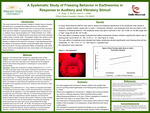
This study examined the parameters needed to reliably induce a freezing fear response to a predator-like auditory stimulus in the earthworm species Eisenia Fetida. Previous work from our lab found that a grunting noise was more reliable in causing freezing compared to a mole sound, i.e. artificial versus natural predators of E. Fetida (Worthen et al., 2024). In the present study, 8 amplitude levels of grunting sound were presented in either serial or random order. The speaker location was varied so that it either did or did not touch the apparatus, thus producing a mechanical vibration in addition to the sound for one group. It was hypothesized that the addition of mechanical vibration would elicit higher rates of freezing than sound alone. We also explored the effects of amplitude order (serial versus random) and amplitude level (low versus high) on the frequency of freezing behavior.
Publication Date
2024
Keywords
Earthworms; Auditory Stimuli; Vibratory Stiumli
Disciplines
Arts and Humanities | Engineering | Life Sciences | Medicine and Health Sciences | Physical Sciences and Mathematics | Social and Behavioral Sciences
Colleges & Schools
Science and Mathematics
Department
Psychology
Repository Citation
Singh , N., Burton , A., & Claflin , D. I. (2024). A Systematic Study of Freezing Behavior in Earthworms in Response to Auditory and Vibratory Stimuli. .
Faculty Advisor Name
Dragana Claflin
Included in
Arts and Humanities Commons, Engineering Commons, Life Sciences Commons, Medicine and Health Sciences Commons, Physical Sciences and Mathematics Commons, Social and Behavioral Sciences Commons